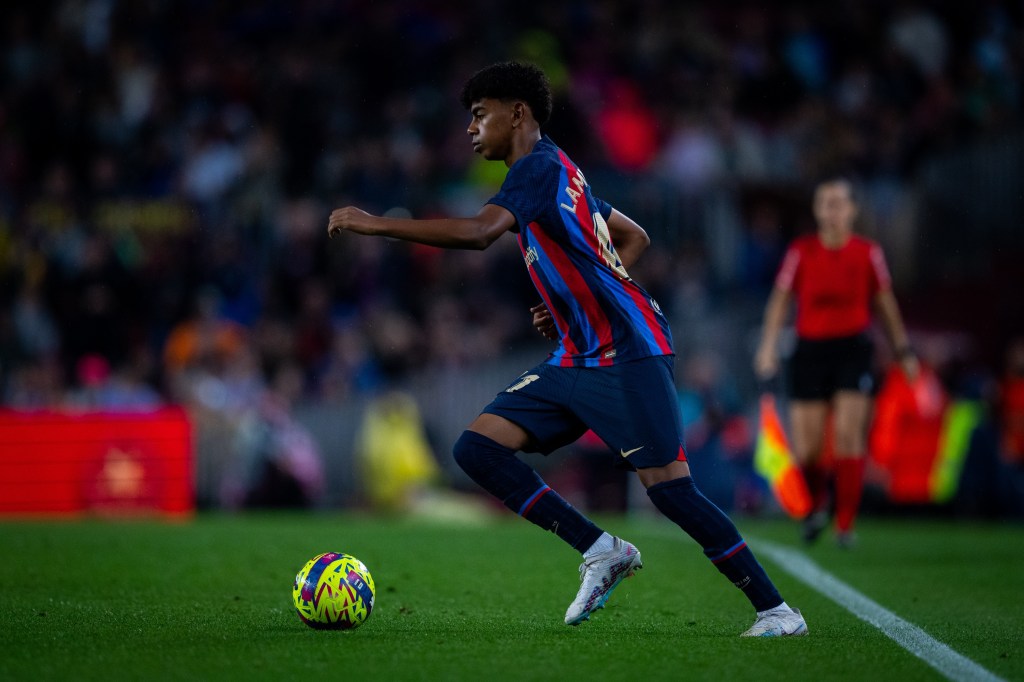
Lamine Yamal has quietly developed a new weapon in his arsenal — one that may redefine how wingers create chances.
His trivela through-ball from the right side is becoming nearly undefendable, and to understand why, we must examine the geometry, spin mechanics, and perceptual biases involved.
Players like Quaresma (shooting) and Modrić (long passes) have used the trivela before.
But using it as a winger to play throughballs is something new — and Yamal’s execution has proven incredibly effective.
The Starting Position
Yamal usually performs the trivela from the right-hand side, aiming to bend the ball behind the defensive line and into the channel between the center-back and fullback.
This location is already tactically advantageous, but the real advantage comes from the orientation of his body relative to the ball’s exit trajectory.
Why Normal Crosses Are Predictable
A conventional cross gives defenders all the cues they need:
- Body faces the target
- Foot angle aligns with trajectory
- Shoulder rotation telegraphs direction
- The plant leg opens the hips
- Swing path is obvious
Because these cues are so clear, the only element of surprise in a normal cross is execution quality.
Defenders are rarely confused about when or where the ball is going.
The Trivela Breaks Every Defensive Cue
With a trivela, the cross itself becomes a surprise.
Right before the pass, Yamal’s posture still looks like a dribbling stance, not a crossing stance.
Defenders simply do not believe that a trivela is even possible from that body shape.
The trivela allows Yamal to:
- Maintain his dribbling posture
- Avoid opening his hip
- Avoid slowing down
- Hide the passing cue entirely
Because he doesn’t need to adjust his body, the ball is already airborne before defenders register the intention.
The element of surprise is built into the technique itself.
Spin Dynamics & Curvature
A trivela produces outside spin (away from goal), which generates a strong Magnus effect.
On the wing, this has enormous impact because it creates a passing line that bypasses the defenders’ blocking cone — the area a defender can cover given their reaction time τ.
Normal pass:
Linear, predictable, easy to close.
Trivela pass:
Curved, late-moving, and shape-shifting.
The ball behaves in two key phases:
- Early flight:
Appears straight and low, like a grounded pass. - Late flight:
Suddenly bends sharply and increases in verticality.
This two-phase trajectory is extremely difficult to judge.
Defenders must estimate:
- Horizontal angle (curve)
- Vertical angle (dip vs loft)
A trivela disrupts both, generating a prediction error that defenders cannot resolve in real time.
Perceptual Biases That the Trivela Exploits
Action–Intention Bias
Defenders assume players pass where they look or where their body faces.
Yamal violates this rule completely.
Foot-Surface Bias
Defenders expect:
- Inside foot → curl inside
- Laces → straight
- Outside foot → rare and usually short passes
Because the trivela is uncommon, defenders lack a trained perceptual model for it, causing hesitation and late reactions.
Why the Trivela Helps the Receiver
This is the most underrated part.
The attacker runs toward goal while the ball curves away from goal.
This seems counterintuitive — shouldn’t that make control harder?
In reality, it becomes much easier for the attacker.
Because the attacker receives the ball on the near side of his body:
- He doesn’t have to look back
- He sees both ball and goal at the same time
- He never has to rotate his torso 180°
- His running line stays forward and balanced
Compared to a normal cross — which usually forces the attacker to chase the ball with his back to goal — Yamal’s trivela:
- Arrives slightly in front and slightly outward
- Slows down as it bends
- “Waits” in the channel
- Meets the attacker instead of outrunning him
This creates:
- Cleaner first touches
- Better finishing angles
- Easier glancing headers
- More control over defender timing
The geometry of the pass directly enhances the attacker’s ability to shoot.
| Mechanism | Regular Cross | Trivela | Why Defenders Struggle |
| Body -> Ball direction mapping | Linear | Non Linear (parabolic) | Prediction error |
| Spin | Predictable | Outside spin -> late curve | Misjudged intercept point |
| Cues(hip, foot angle) | Clear | Hidden | Slower Reaction |
| Required Space | Large | Very small | Harder to block |
| Trajectory | Stable parabola | Hybrid straight -> curve | harder to time |
| angle of release | Expected | Surprising | Forces reorientation |
The blind spot is a critical aspect. The trivela is designed to consistently beat the nearest defender. The receiver should exploit the defender’s blind side by making a well-timed penetrating run (Spielverlagerung/Laufweg). The ultimate success hinges on whether a second defender positioned deeper can read the pass. Beating that player relies entirely on the passer’s and receiver’s superior anticipation and execution. This makes the following example of Yamal’s trivela a textbook situation.
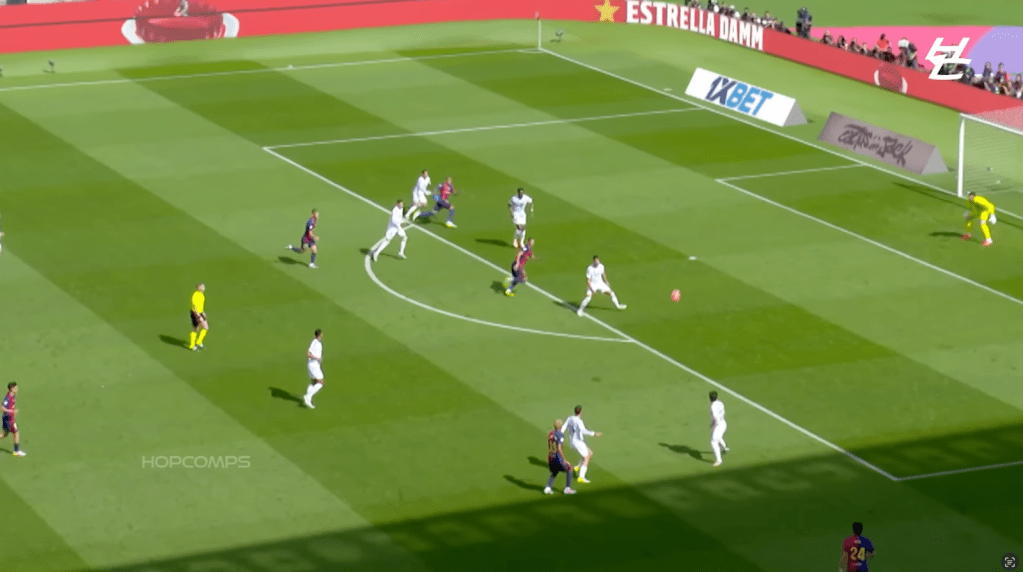
1. Yamal enters the trivela zone
This is classic asymmetric information.
Raphinha knows Yamal’s tendencies from training, so he anticipates the trivela before defenders do
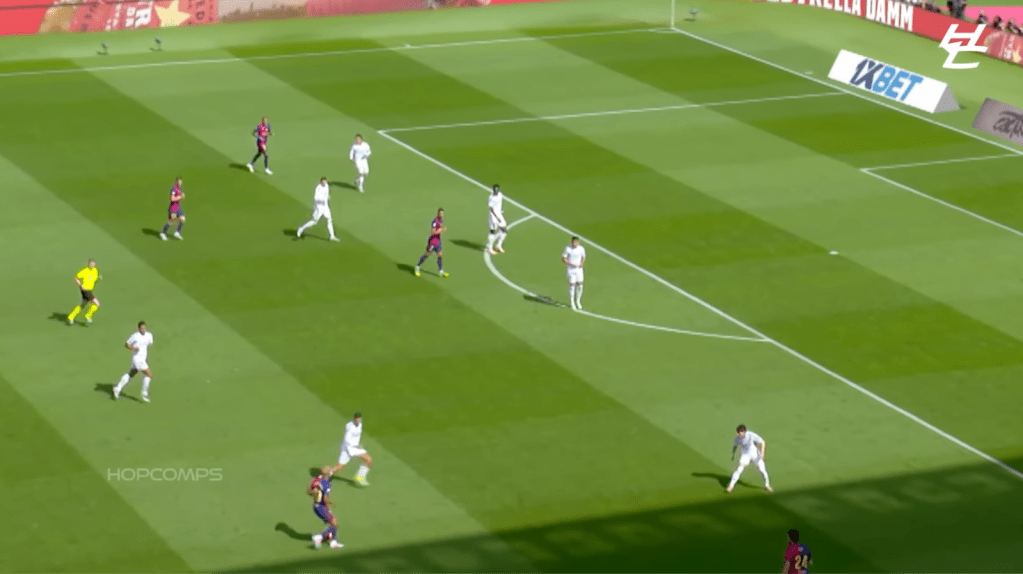
2. Early run from Raphinha
As seen in the image, Raphinha initiates his run before any Real Madrid defender recognizes the passing cue.
Namnlöst dokument
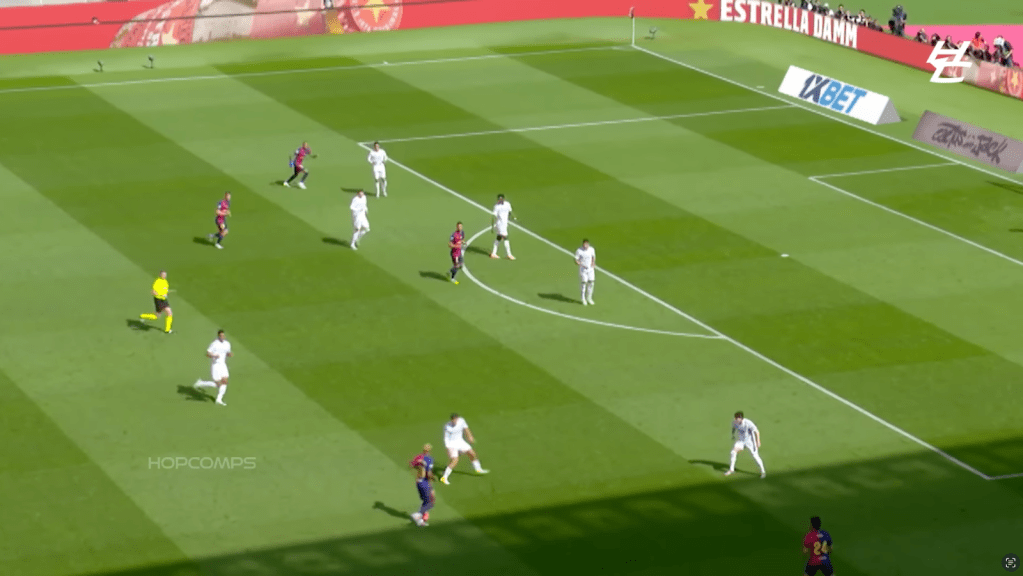
3. Only one defender senses danger
The right-back begins adjusting, but the center-backs are still unaware.
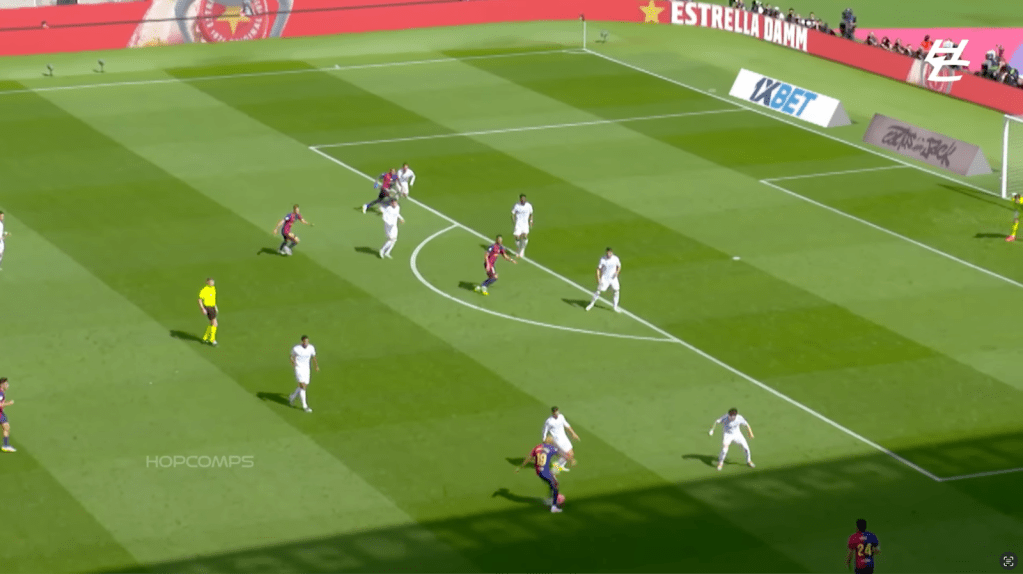
4. Yamal initiates the pass without telegraphing
Because of the trivela mechanics, the defender marking Yamal cannot read that a cross is happening — he expects a dribble or simple pass.

5. The decisive moment
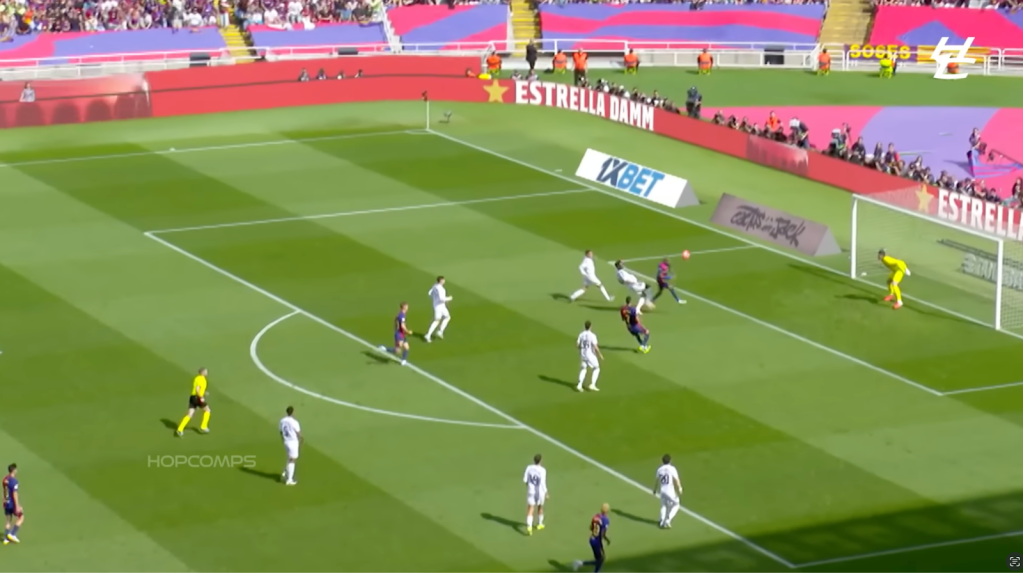
As the ball leaves Yamal’s foot, the bend increases sharply.
Raphinha has already beaten his marker through anticipation and acceleration.
Look at the defenders’ foot positioning in the image on page 6:
They are flat-footed, unable to read the ball’s curved trajectory.
6. The header opportunity
The ball curves away from goal and loses speed — ideal for a controlled glancing header.
Raphinha meets the ball perfectly, though he ultimately misses.
Yamal still creates a massive chance through geometry and deception alone.
 The Football Algorithm
Leave a comment