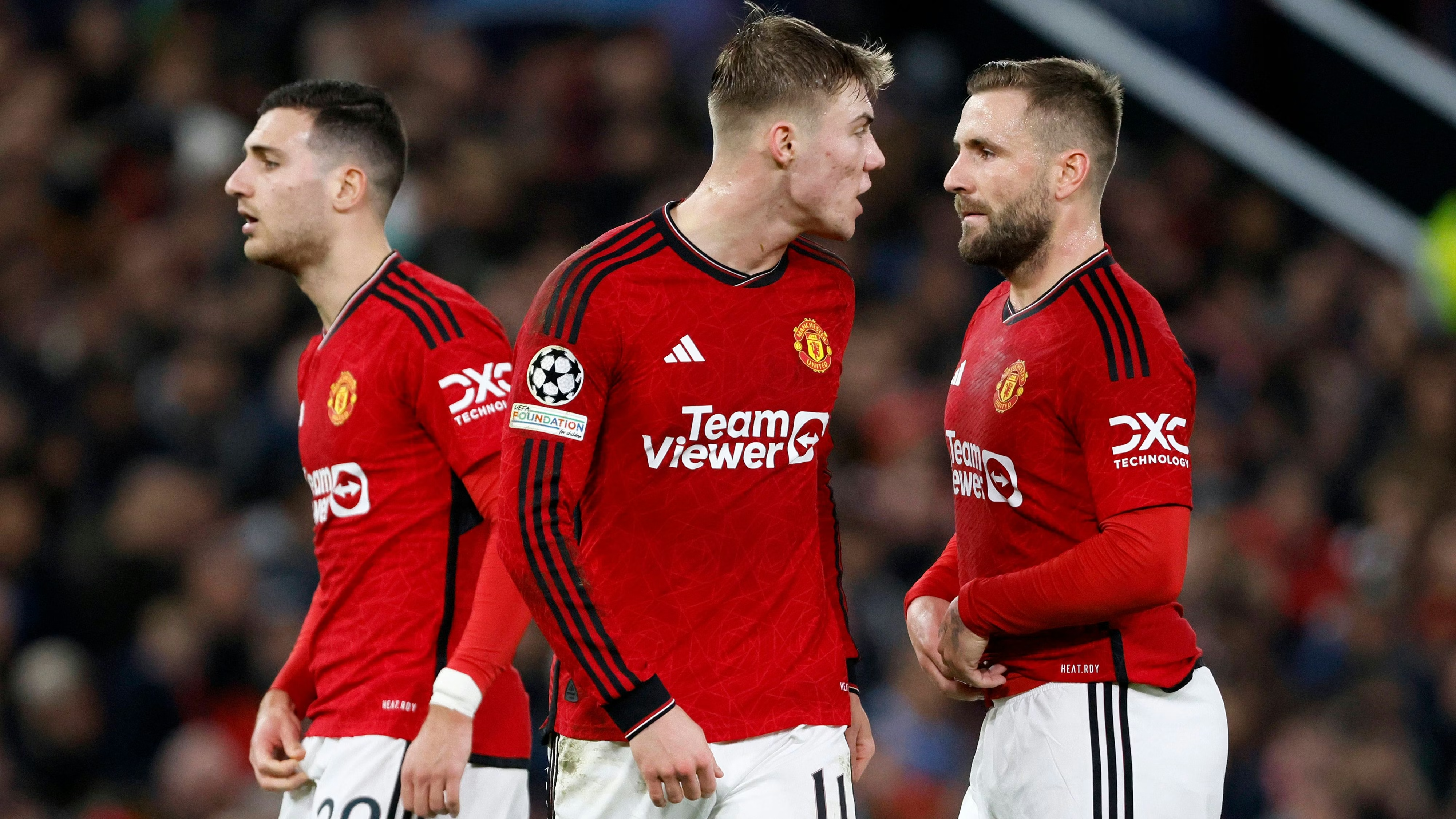
Manchester United has been on a downward spiral for the last 15 years since the end of Sir Alex Ferguson’s tenure. The club has experienced a constant roller coaster in which optimism and pessimism have interchanged. Since Ferguson, the club has had six coaches, all getting sacked one way or another. It has started to look like a curse is slipping into the club in the same way it felt for their arch-rivals Liverpool, who had not won the Premier League for 30 years. It all came to a head last season as the club reached its lowest point in the modern era, finishing 16th and losing a European final.
A couple of months later, optimism has started to spread following their strong opening in the Premier League. But what is more encouraging are the moves the club has made outside of the football pitch. Moves that have transformed the culture inside the whole club and created real systematic change for the first time in over 15 years.
The INEOS Takeover and Structural Revolution
The INEOS group acquired 27.7 percent of Manchester United in 2024, and the critics have been many, seeing them as a shield for the Glazers, who still maintain majority ownership. The start of their tenure has been catastrophic from a results perspective, with last season ending as the worst season in the club’s history. Nevertheless, the seeds they have sown are starting to reap their fruits. To understand the transformation INEOS has made, you have to understand how the club is set up now.
Their first move was to hire Omar Berrada as the CEO of the club. Berrada was a different profile to the previous CEOs. He came from their neighbor rivals Manchester City, where he was the Chief Operating Officer (COO) between 2016 and 2020. Later, he became Chief Football Operations Officer for the City Football Group. In contrast, previous CEOs Ed Woodward and Richard Arnold had no football backgrounds. Woodward was an investment banker with no previous experience in football. He was instead appointed because he helped the Glazers acquire the club. Richard Arnold, likewise, was an accountant with no previous experience managing a football or sports team. The club at that time was hiring for these roles not on merit, but on personal connection. In any business, not only in football, this is a recipe for failure. With a new CEO hired who was part of a team that dominated English football, INEOS was finally trying to solve the sporting director problem.
Why Recruitment Is Everything
Success in football comes down to recruitment and money. The club had the most money and was also the largest spender in the Premier League. Nevertheless, it showed that regardless of the sums the club splurged on players, if the recruitment side of the club is bad, it will not matter how much money the club has. Another misconception about United is that they spent the money on the wrong players. While this is true in a wider sense, the club has purchased many players who elevated their careers after leaving the club. This points to the fact that recruitment of players does not only come down to buying the best players, but to having a process. In that process, factors such as adaptability, player fit, mental profiling, and more have to be taken into account. Furthermore, the relationship between the manager and the recruitment team is integral in acquiring players the manager is able to utilize. A problem the club has faced is the constant change of coaches and no clear philosophical cohesion in the appointment of coaches. Alternating between attack focused and pragmatic approaches, between seasoned veterans and young innovators. This creates confusion and instability.
The Sporting Director Solution
A big point of contention for the club in the last decade has been not having a sporting director. Instead, the director of football had the role of sporting director. Hence, managing recruitment was previously delegated to Woodward and Murtough, both of whom did not understand football. In 2024, United finally decided to appoint a sporting director and brought in Newcastle United’s Dan Ashworth. Although he only stayed for seven months due to the transition of ownership, it was a step in the right direction. The man replacing him was Jason Wilcox. A couple of months later, he was named the director of football. Wilcox had previous experience as academy director of Manchester City and sporting director of Southampton. On June 4, 2025, he was appointed as director of football. Finally, United had a long-term director of football with actual football competence.
But the chess moves to reorganize Manchester United’s management had already been in motion. In 2024, they appointed Christopher Vivell as head of recruitment. Another key addition was the appointment of Michael Sansoni as head of data. Sansoni was sought after because of his successful stint with Mercedes in Formula 1. Simon Stone, football reporter for the BBC, reported that Sansoni has helped the club revamp their data capabilities. One source said that United’s data and analytics team has accelerated at such a level that they are now amongst the top in the Premier League.
Smart Signings and Data-Driven Strategy
The new signings under Vivell have shown to be promising at this time. The majority of signings from the 2024 season have been promising so far, such as De Ligt, Dorgu, Mazraoui, and Leny Yoro. In the last window, the club was able to purchase Mbeumo, who has proven to be one of the better players in the Premier League this season. There were reports that came out from their data team which had deemed Mbeumo to be the “closest” to Mohamed Salah. This is evidently turning out to be true. Another signing that looks promising is the purchase of Senne Lammens, whom their data team pointed out as one of the best young goalkeepers in Europe. The signing was scrutinized due to the immense pressure the 20 year old would have to endure being bought as their first team goalkeeper. Lammens has so far proven to be reliable, which is surprising given his inexperience.
Furthermore, they seem to be able to target the right type of players as of late. Instead of focusing on getting star players with high wages and transfer fees, they are starting to follow the steps of other big clubs such as PSG and Chelsea in acquiring the hottest prospects.
In the last few weeks, reports have come out of them targeting Bouaddi, Jeremy Jacquet, Elliot Anderson, Agoume, and Baleba. These are players that show a clear data-driven strategy. The reason is that they are players who are excelling in advanced stats such as progressive passes and expected threat, for instance. Tim Waskett, who works in the analytics team of Liverpool, said,
“The primary currency of football is goals, and it is our job to turn every action that is on the pitch—every pass, every throw, every shot—into a goal probability.”
Tim Waskett
This is a fundamental truth about what teams with data-driven strategies are looking for. Young players who show potential in these metrics are being chased as clubs hope to develop them into some of the best in the world.
Historical Parallels: Breaking the Curse
Hence, even though INEOS has had a rough start at the club, there has been a complete makeover of the structure of the football club, with an emphasis on bringing in new and modern staff. This is what turns clubs around.
The Boston Red Sox had not won the World Series in 100 years and were widely regarded as having the biggest “curse” in sports. In some way, the belief in a “curse” gives it real consequences due to its role in the culture of the club. But what ended the “curse” in 2004 was the new direction their owners, the Fenway Group, had. They were the first to go in the moneyball direction. Moneyball is a term describing a data-driven approach that uses advanced statistics to find undervalued players. In the following 20 years, the team was able to win four World Series titles. In a similar fashion, with the same owners, the Fenway Group, Liverpool was able to end their 30 year league title drought, in large part due to a 10 year investment in a data driven recruitment policy headed by Michael Edwards.
Manchester United already has the most money, the biggest predictor of success. With the right culture and structure, it will in the long term result in the money materializing in better recruitment. Hence, it isn’t a long shot but instead likely that United has shown enough that they will be in contention for the biggest titles very soon again.
 The Football Algorithm
Leave a comment