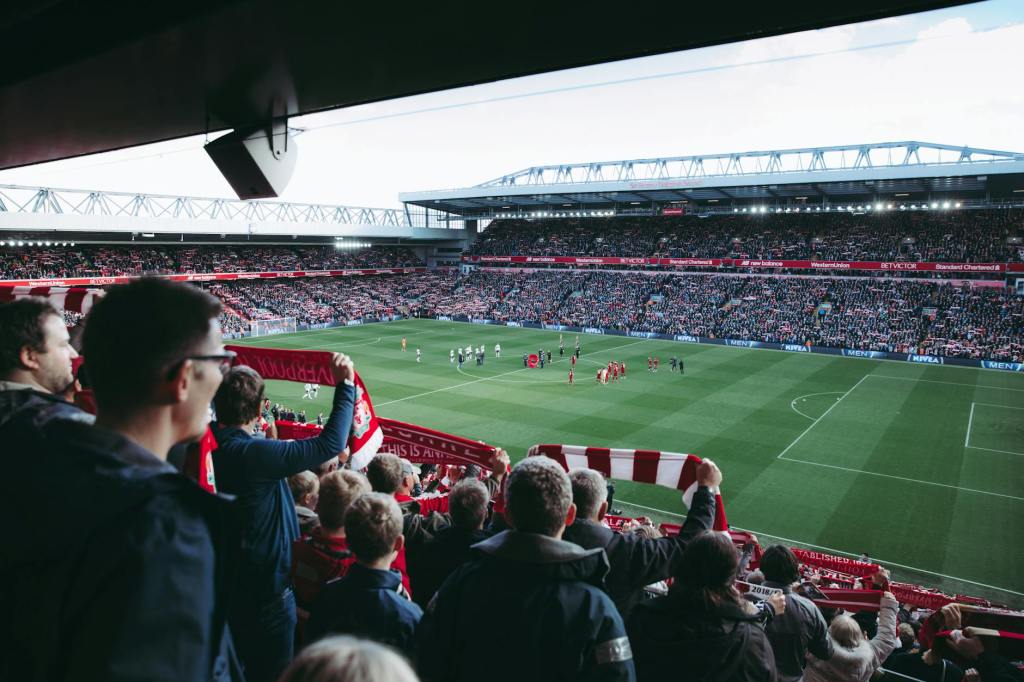
Liverpool is interested in signing Andrea Bastoni for a transfer fee well over 90 million euro. Liverpool has long been seen as the frontier when it comes to data driven recruitment policy. And there is a quite unorthodox reason why Liverpool is chasing the Italian defender. What it reveals is the new way recruitment is pursued when it comes to defenders. But before that let’s talk a little about Bastoni.
Bastoni is a 26 year old defender who has been one of the best centerbacks the last few seasons in one of the best defensive teams in Europe. The Italian international has been a cornerstone of Inter Milan’s defense since breaking into the first team in 2019. Playing a crucial role in their Serie A title triumph in 2021 and their run to the Champions League final in 2023. His development under Antonio Conte and later Simone Inzaghi has been remarkable, transforming from a promising academy graduate to one of Europe’s most complete defenders. What makes his trajectory particularly impressive is how he has evolved in a back three system. His left-footed comfort allows him to play as the left-sided centerback in Inter’s back three, where he serves as both a defensive anchor and a primary ball progressor. What separates Bastoni from conventional defenders is his ability to carry the ball out from the back under pressure, execute perfectly weighted long passes, and maintain composure in tight spaces, skills more commonly associated with deeplying playmakers than centerbacks.
Now why is Liverpool going to go all in on Bastoni? To understand it, we have to understand the evolution of football in the last couple of years. Especially when it comes to defending. Teams today all across the board are much better in all areas of defending. The data backs this up dramatically. FIFA’s technical analysis of the 2018 World Cup revealed that defensive blocks had become significantly more compact compared to 2014, with teams maintaining an average of just 26 meters between their deepest defender and highest attacker when out of possession. As Carlos Alberto Parreira, Brazil’s 1994 World Cup-winning coach, observed: “Space between the lines was practically non-existent.”
This trend has accelerated in recent years, particularly across Europe’s top leagues. Analysis of La Liga shows an increasing adoption of especially compact defensive structures, making it progressively harder for top teams to consistently penetrate weaker opposition. The gaps that creative players once exploited are closing faster than ever before.
Hence it has become much more difficult for the top teams to consistently penetrate through the weaker teams. This has resulted in creative players getting no space to get passes between the blocks as the defending team is able to close the gaps much faster and quicker than ever before. Hence deep playmakers are getting more and more valuable as the blocks are not able to have the same closeness when the ball is in the first third of the pitch. Therefore we are seeing a trend where technical ability is more important in the defensive position than ever. This has resulted in midfielders moving down to fullbacks and even centerbacks. Most recently O’reilly for Manchester city, he has started to play at the left back position. These players are more skilled in being able to make the line cutting passes which are able to hurt the weaker teams compactness. The most valuable defender in this regard is without a doubt for the last couple of years Trent Alexander Arnold. He constantly scores first in statistics such as, ball progression and progressive passes. This has been a huge reason for Liverpool’s struggles this year. Players such as Salah are receiving the ball in much less frequency in this important position than before. A tactical analyst noted that “there is even more compactness in the matches played than Rafael Benitez was striving for with his Liverpool side 20 years ago,” and that “skillful players can still thrive, but there is less time and space on the ball compared to decades prior The Football Analyst.
This has been evident for players in Liverpool since the delivery isn’t as good since Trent has left, it has led to Wirtz and Salah to have much less time before opposition players are on them. Trent was able to transport the ball from the first zone of the pitch into the third zone in one touch. Disrupting the compactness and structure of opposition defenses. Allowing Salah, Diaz and Nunez to receive the ball with space and in dangerous areas.
This has been a trend mostly regarding fullbacks, but that might be changing. Ball skills have always been important for center backs. However, they have never been emphasized like this before.For top teams in the future, having two elite ball-playing center backs will be essential. This is especially true as lower-tier teams continue to improve defensively. This leads us to Andrea Bastoni. He is not a normal center back. He is probably one of the most modern center backs in today’s game. In fact, he is one of the best ball progressors in Europe at his position.
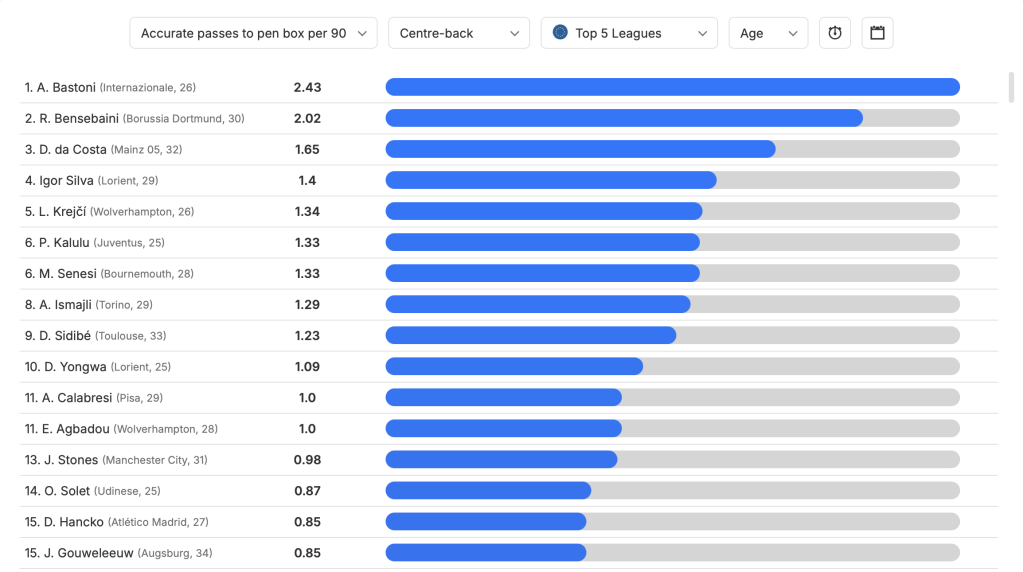
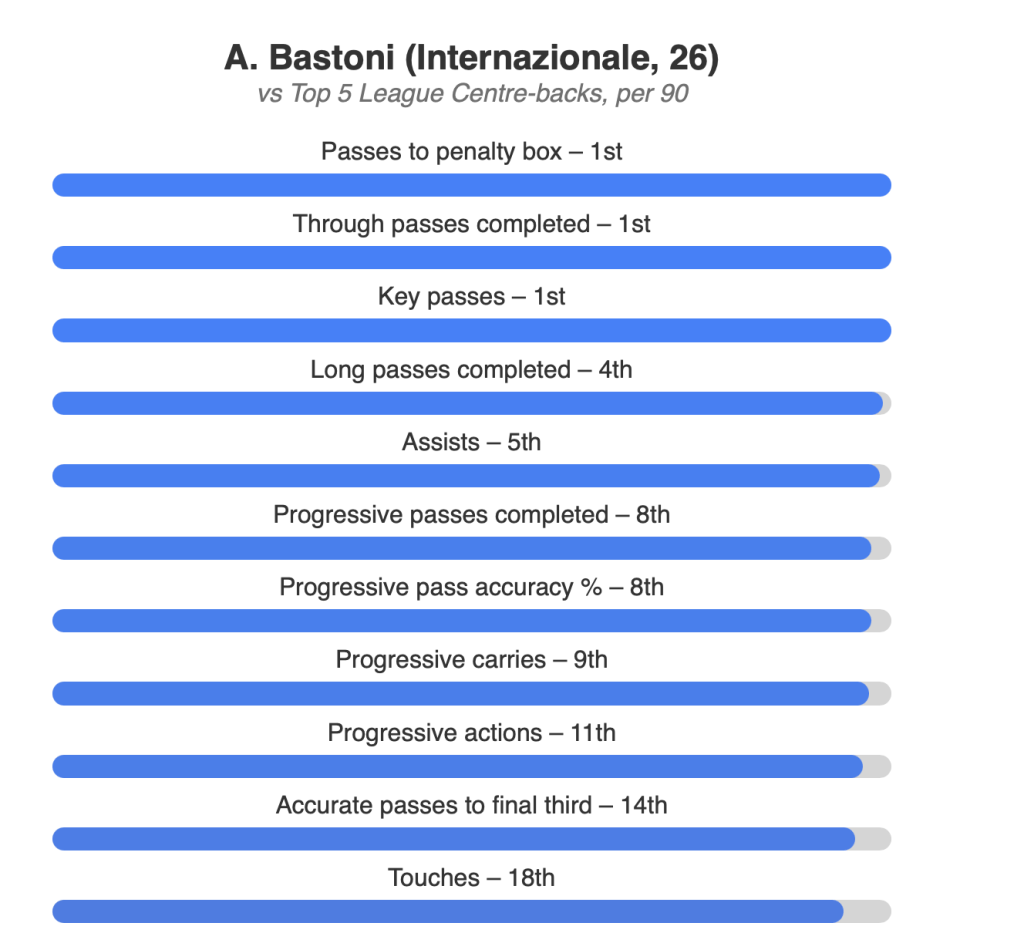
The index shows that he is one of the best ball progressors in his position in all of Europe. Bastoni’s ball progressing ability combined with being one of the best defenders in the world explains why Liverpool is considering breaking the world record transfer fee for a CB.
Liverpool has a big issue. Much of its deep playmaking and line-breaking was done by Trent Alexander-Arnold. From a Moneyball approach, it’s evident that no single player can replicate his output. He scores in the 100th percentile in xA, progressive actions, forward passes, and passes to the final third. Instead, Liverpool will have to aggregate his contribution across several positions.
This is why Liverpool has been targeting Adam Wharton as their new number 6. He is one of the best ball progressors in the game today from the midfield position.
If we take a broader look at this development, it reveals something about the modern game. We are moving into a positionless era. The requirements for playing defender in a top team now demand immense quality on the ball. Defenders must pass through lanes and create chances.
This will see teams continue converting midfielders into defenders. We’ve mainly seen this apply to the transition from midfielders to fullbacks. However, we’ll likely see more midfielders converted to center backs. Most center backs in top teams will require such high technical ability, athleticism, and dynamism that they can operate in multiple roles—from fullback to central midfielder.
A huge reason for Manchester City’s treble-winning season was Pep Guardiola’s new system. It saw John Stones transform into a midfielder alongside Rodri in a 3-2-4-1. In the future, we will likely see more of this. Center backs will play different roles in possession versus out of possession. This creates entropy. Teams can be both unpredictable and measured—controlled chaos.This is necessary because the median level of defending across Europe is gradually becoming stronger. It will require different tools and skillsets to consistently beat the “smaller” teams. More on this in later posts.
 The Football Algorithm
Leave a comment